What
a Girl Wants
In our fast-paced modern
world, we are constantly faced with and influenced by the media. From
television to magazines, billboards to the internet, there is no escaping the
messages that we are bombarded with on a daily basis. ‘Buy this product and
people will like you more’….’buy this and you will become rich and handsome
overnight!’ Unfortunately, the subtleties are more than just superficial. The
messages getting through to people, especially young girls are doing more harm
than good. Constantly we are being told, through the media, that we are not
good enough-not pretty enough, not skinny enough, not perfect enough. When
everyone we see in this magical world of the media is perfect, we start to
think that, perhaps, we are not adequate. Perhaps we are not going to be
successful in life if we do not fit into the little box created by our society.
But what messages, exactly, is the media sending to us? What effects do these
messages have on people, especially young women? And when did beauty become a
more admirable asset than intelligence?
1.
Source one- advertising


(Clockwise from bottom right:
http://quizbazaar.blogspot.co.nz/2010/07/diesel-stupid.html, http://twilightersanonymous.com/tag/runaways,
http://funkbyfarah.blogspot.co.nz/2010/08/evan-rachel-woods-and-chris-evans-for.html,
Although we don’t like to
admit it, advertising plays a very large part in our lives today. Everywhere we
go; blatant advertising is shoved in our face. Billboards, at bus shelters, in
magazines or on the television, there has always been, and always will be, that
very primitive but very effective way of getting people to buy (or do) things.
Whilst there are other types of advertising, this form is the least
subtle-every advertisement will no doubt be plastered with a brand name-so that
you know exactly who to go to be just like the people in the add Unfortunately,
advertising is never just as simple as ‘buy this product’-in order to be as
effective as possible, everything you could ever dream of is made to look
absolutely perfect in the shot-be it a television commercial or a page in a
magazine. Even in still pictures-like the type that can be found on billboards
or in magazines-the messages that are conveyed to you, as the consumer, are all
aimed at getting you to buy that product.
Especially in still-shots, because everything has to be conveyed across
in that single moment, it is crucial that everything fits together like a
jigsaw that gives you that intoxicating sense of “o.m.g, I must buy that!’.
Unfortunately, the advertising industry has only one aim-to make money-and,
even worse, the messages sent to us that ultimately sell the product are not
always the best. Everyone, no matter who they are, wants to live rich,
prosperous, glamorous lives-just like the people in adverts. You may think that
this is not true but, the fact is, advertisements work because they give you
that sense that ;if I but that, my live will be just as perfect as the people
in that ad’. In our world, being perfect is to be like movie stars, celebrities
or supermodels-therefore, unfortunately, the messages sent to us via the
advertisements ultimately revolve around the ideas that you WILL be prettier,
you Will be skinnier, you WILL be more popular with everyone if you buy this
product and, therefore, the people we see in the advertisements, these ‘perfect
people’, are almost always flawless by our modern standards of beauty.
That means, though, that the
people we most desperately want to be like are often not setting a healthy
standard-very few people can be just like them because they have, more often
than not, had surgery, eating disorders and make-up, not to mention airbrushing,
before their image is seen by the public. If you look at the Duncan Quinn
advertisement at the top of the previous page, a model is draped over the
bonnet of a car, flat stomach exposed for all to see. Although she is not quite
at the starving to death stage, she, no doubt, is far skinnier than the average
woman-and, you can almost guarantee, her body was subject to a lot of Photoshop,
to reduce her size even more, before the advertisement was published. Images
like this one, and even the Gucci one to the left of it, all set a very
challenging standard of beauty-one in which slimness is favored over a healthy
weight and goddess-like features are the only way to be, even if plastic
surgery and make-up must be used to get there. These ‘ideal women’ we are
constantly faced with, with all their extreme, pigeon-hole ideals of the
perfect figure, are not what we should be aspiring to.
Firstly, as earlier
mentioned, these standards are not safe to aspire to for grown women-yet alone
young girls who are not even fully developed yet (Who, as much as adults would
like to believe, do actually see advertisements as much as them). Girls who see
society’s ideals through advertising think that they should be like the models,
actresses and pretty girls they see and, therefore, often end up developing
eating disorders (such as anorexia or bulimia), wanting plastic surgery or, as
most commonly, constantly feeling inadequate with their body. The problem is
that, according to About.com, the average American (and, no doubt, New Zealand
and other nationalities) woman is 5’4” tall and weighs 140 pounds. By
comparison, the average model-who we are constantly told we should want to look
like-is 5’11” and weighs 117 pounds. When there is such a difference between
what is normal and what is not, can we ever really meet these standards of
beauty? Should young girls, who have not even developed yet, be starving
themselves and feeling inadequate because they do not meet these, so uncommon,
variables? Mental disorders, especially anorexia, are not only often deadly
and, at the very least, hospital-grade dangerous, they can have lasting effects
on a person’s health. If a child or teenager has an eating disorder, the
chances are likely that they will end up stunting their growth and never reach
their full potential height. When
metabolism is developing, it might be damaged to such a degree that, although
being skinny as a child, when they start eating healthily gain, they actually
gain weight because their metabolism is so slow because they fixed it from not
eating much before. Being overweight, although not posing the same risks that
being underweight does, also causes dissatisfaction and feeling of inadequacy
that being underweight does.
Besides from the serious
dangers that can be explored by wanting, so desperately to be like the women we
see in adverts, there are also those psychological feelings that we aren’t good
enough. When everyone is so different-from size and shape to looks and
ethnicity-I find it absurd that the recognized type of beauty is very typecast.
Standards of beauty come and go. For example, in Botticelli’s time, women with
voluptuous curves were favoured over women who were skinny and artist’s
paintings reflect this-even as little as sixty years ago, women who were skinny
were seen as undesirable because they were not as healthy and, therefore, not
as wealthy and able to afford food, as larger women. Even though being a
healthy weight is better than being underweight, health problems that are just
as bad for you can be also linked to being overweight. My point, of course, is
that society, through advertising, sets a very exclusive idea of beauty and, if
you’re not in that category, you are often made to feel inferior. This is
despite the fact that very few people look like models-can look like model and
actresses-which we see in the media. When everyone is so different, shouldn’t
we try to encourage individuality? In my opinion, if everyone was taught to
value their own personal beauty rather than think that they are ugly because
they don’t look like everyone else, the world would be a much happier, less
negative place-sure, plastic surgeons would be out of a job but, really, I
think they do more harm than good.
A second issue that we, as
women, face in advertising is that of sexualisation and sexist attitudes
towards women. Again, the whole idea of advertising is to make you want to buy something
and, because society dictates it, sex sells. The producers of advertisements
have figured out that everyone wants to be more attractive to the opposite sex
because, to complete this image of perfection we are told to aim for, sexiness
is the cherry on top. Sexiness is cool, glamorous and exciting. To be sexy is
to be lusted after, feel valued and wanted. In our modern culture more than ever,
sexiness is to be a goddess. Sexiness is to be powerful.
However, this message, like
that of having to be pretty or having to be skinny, is not exactly ideal. If
you look at all of the advertisements shown previously, all of them (and
probably all of the advertisements you’ve seen today) will have some aspect of
sex in them. The image for Diesel, a very popular clothing brand, depicts a
young woman standing on a ladder, pulling her top off to show her chest to a
security camera. The image for Gucci, an even more successful brand, shows two
people, no doubt naked, engaging in some obvious sexual conduct. Even Dakota
Fanning, a famous child actress known for her down-to-earth qualities, is shown
in a Louis Vuitton advertisement here with an oversized perfume bottle in a
very compromising position. Whilst these advertisements all seem to show women
voluntarily enjoying whatever male attention they would no doubt receive if
these actions were played out in real circumstances, the Duncan Quinn
advertisement, again an advertisement promoting sex, seems to be pushing the
boundaries with its underwear/bikini clad girl stretched out over the bonnet of
a car with a man looming over her and appearing to choke her. Because of the
nature of these advertisements, which are so focused on lust, we are led to
believe that we should value quick desire over lasting relationships based on
love. Is this really the message we should be sending out to young girls? That,
never mind love and trust in a relationship, lust-sleeping with different
people every day of the week and
not caring-is much more aspirational.
Despite the bad values that advertisements like this teach
us, they are also incredibly degrading to women in that they make women out to
be objects. Going against all our ancestors worked for in women’s rights and
gender equality, the messages here are that women are to be treated as nothing
more than tools for quick pleasure. That women have no other values than to be
useful for sex. That women should be valued much more for their ‘hot body’ and
sex appeal than any actual skills that they posses-such as intelligence. It is
showing the male to be the dominant species, the male to be the King, the ruler
of the planet because he has the power-not, god forbid, the females (whose sole
purpose, if we believe advertising, is sex and housekeeping). These negative
connotations are extremely downgrading for every women, especially young girls
because it is teaching us that we are not as good as men. The
media-advertising, television and the internet would all have us believe these
messages and, if we’re not careful, we might end up in a position similar to
that of our ancestors, who were not treated with the same rights as we are
today.
Besides from all this, these
advertisements we are faced with often enforce ideas of sexual abuse. Often it
is thought of as quite a secular issue-due, mainly, to men who are not quite
right in the head. Yet, the messages given to men by advertising can be quite
derogatory and, even, dangerous. In this advertisement, a young woman, clearly
terrified, is being forced into sexual activity by a man. Rather than highlighting
how dangerous this is-psychologically and physically and abusively-the
advertisement makes light of the fact that the woman is being raped with the
tag: “unlike some people, Belvedere (the name of the Vodka brand being
advertised) always goes down smoothly”. In another advertisement, a women lies
on the ground whilst one man presses onto her. A group of men looms in the
background, suggesting something a lot more sinister than harmless sex.
Rape-gang rapes, date rape……none of these things are good things and for advertisements
to be sending the message that these acts of violation against women are
acceptable is shocking. If girls are exposed to these horrible messages, if
young boys and teenagers get the impression that these things are okay, the
future looks pretty bleak. Boys grow up to think that it is okay to treat a
woman abusively and with little respect. Girls grow up to think that this is
how they should be treated-no matter the pain (emotional and physical) they
experience from sexual abuse. With these messages, people are raised to think
that sexualisation is a good thing, a good asset to be ‘sexy’.
But what about the
consequences? These advertisements give a very negative attitude towards sex.
Because of them, younger and younger girls are being lulled into the idea that,
if you want to be popular, be sexy. If you want boys to like you, wear
provocative clothing. But this isn’t the idea that should be portrayed. With
more sexualisation in the media and advertising, girls are getting into all sorts
of trouble for behaving like the advertisements they see. Teen pregnancy is a
big issue in the Western world because girls who leave school to look after a
child are so much more likely to end up worse off later in life because they
never get the qualifications and education that can get them good jobs. Girls
are losing all sense of pride in their self-thinking that, as long as they
aren’t wearing much, the attention 9despite it not usually being good) will be
there. Are these really the sort of messages we want the media to portray to
us? For some reason, that’s what the media thinks.
2.
Source
two-television (specifically Beauty and
the Geek)
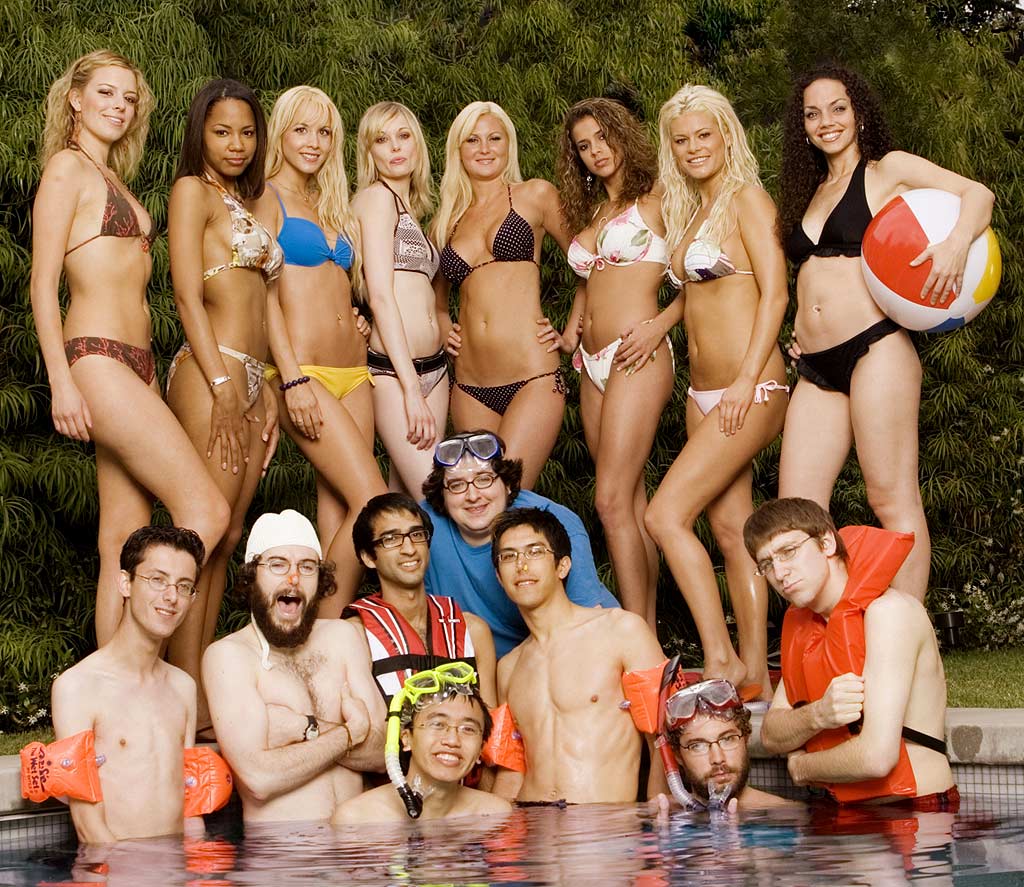
Sources: (from left to right):
http://images.fanpop.com/images/image_uploads/Season-3--Cast-beauty-and-the-geek-203496_1024_887.jpg
 |
|||
 |
|||
Another form of media we are
faced with in our day-to-day lives is television. Today, in our high-tech world
there exists a myriad of different entertainment feasts on which to spend all
day watching. From cartoons, like Family
Guy to more serious programs such as King’s
Cross ER and everything in between, it is no wonder that today’s average
child reportedly spends more time watching television than they do anything
else bar sleeping. Although some people might argue that television is
educational, it is widely accepted that it is primarily entertainment in a box.
More recently in the television timeline, there has been a surge in popularity
of reality television programs. The messages being sent to people through this
programs-not to mention young girls-are questionable at the best of times. One
of these programs which send very negative messages to young girls and
teenagers is that of Beauty and the Geek.
Hailed as a ‘social
experiment’ Beauty and the Geek is a
reality television program in which female ‘beauties’ are paired up with male
‘geeks’. In competition format, with one pair being eliminated at the end of
each week’s episode, the pairs must compete in a series of challenges designed
to be difficult for the stereotypical beauty or geek. For example, beauties are
often tasked with math problems and geeks with social tasks like bartending. The
beauties are almost always women (although, in an effort, perhaps, to be less
controversial one season of the American version of the show included a male
beauty) and the geeks always men. Portrayed as gorgeous-by our standards of
beauty- women, the beauties are always unbelievably stupid and ditzy, whilst
the geeks fit perfectly the typecast image of a ‘geek’-that is, unattractive,
not very social but incredibly intelligent. Although entertaining, this very
popular program, like so many others constantly screened to us, is not exactly
sending the right messages to young girls.
For starters, the program is
extremely sexist. Within the media, it seems to be the accepted norm that men
are the smart, intelligent sex and women are the pretty, but ditsy second-best
sex. This is not so much highlighted as shoved in the faces of anyone who
watches Beauty and the Geek- the
geeks (stereotyped as intelligent but unattractive) are men and the beauties
(stereotyped as stupid but attractive) are females. This gives off all sorts of
negative messages to girls watching the show. It supports advertising and the
current social attitudes that women are the less intellectually powerful sex
that women should be pretty but men are the ones who should be smart. That boys
can grow up to be astronauts or presidents or lawyers-jobs that make a
difference in the world- but that girls can only hope to be beauty therapists
or receptionists. In the past, a woman’s primary role was to stay at home and
look after the house and children. Over the last half-century however, all the
years of women campaigning for equal rights has gradually developed into it
being more socially acceptable for women to have just as intellectual careers
as men. Women, who at first were allowed careers as nurses or secretaries,
nowadays can feel confident that they will get just a well-paying and
interesting job as men. However, this is not the message that this program is
sending to impressionable young girls. By making the ‘beauties’ primarily
women, who are valued only for their looks and who have jobs in areas such as
beauty and fashion, this program is reinforcing these very narrow stereotypes
that women have been trying to escape for so long. Sure, some women/people have
a real passion for so called ‘girlie’ things but the media should be seeking to
create diversity-not narrow down the options for women. Lots of girls do grow
up to be successful scientists and entrepreneurs but, if they watched Beauty and the Geek they would never
even realize that women can be anything other than stupid. That men are not,
shouldn’t be, the dominant gender. But that is the very negative message being
sent out to young girls who watch this program. That is the extremely
demoralizing message so common within our media. Girls who are exposed to this
program will lose self esteem because they will think that they can’t be smart
and they can’t be successful. They will begin to believe that all women should
be pretty-but never clever. They will, themselves, try to act stupid because
the so-called ‘role models’ on this program act like that. If this message
keeps being sent to young girls, more and more of them will grow up to never
reach their full potential. I, for one, do not like the way in which this
program stereotypes against women (and against men) because everyone is
different and girls need to know that there is more than one type of woman out
there.
“I never, ever, in my life
thought that I was smart” –Megan Ryan (a Beauty from season 4)
A second reason why this
program is a very negative influence is that it sends out the message that
beauty is a more important aspect than intelligence. In our culture, laziness
has taken over from good work ethic and, as mentioned earlier, the message getting
across to people is that beauty will get you further in life than brains. This
might be true for a select few people-models and actresses who become very
popular, for instance-but very few people will end up with that glamorous
lifestyle they think will be so obtainable if only they are good-looking. In
advertising, people, especially women, are told that they will be popular and
rich if they buy that product. Therefore, the picture of the ultimate woman is
portrayed through the media and, unfortunately, what is aspirational in our
modern culture is beauty-not brains. This program does help to reinforce this
idea. Whilst the beauties are laughed at for their stupidity, it is the geeks
for receive make-overs. This is due to the fact that they would otherwise not
be accepted in our society, due to being thought of as unattractive. So, whilst
the beauties are not clever, all the emphasis is put on the geeks for not being
good-looking, highlighting how our culture does value good looks and
attractiveness over intelligence. I think that this is not the message that
should be portrayed to children-or anyone who watches the program because, for
one, our society has a very narrow opinion of who is beautiful and who is not.
Throughout history, this has been the case-but, even though it is not a new
thing, it still makes people who do not fit into that small box feel inferior
(and, no doubt, picked on for being different). This message and therefore this
program are merely encouraging bullying within schools and making smart girls
feel like they shouldn’t want to be smart. For both boys and girls, this
message is portrayed is extremely negative as well because there is a place for
intelligence in our society-but, by watching Beauty and the Geek
you would wonder. Intelligent people are needed because they are the ones
who run our country-without smart leaders, the world would end in anarchy. On a
less severe note, without intelligence, there would be no one to laugh at the
absurdity of reality television.
3.
Source three:
Book and film women role models (Bella Swan vs. Hermione)
(Left to
right):
 |
|||||
 |
|||||
 |
|||||
A further form of media so influential in the lives of people today is
books and films. Although, especially with novels, it does not seem like ideals
are portrayed to girls, they are. Films are watched by people who cannot read,
making the ideals from female role models even more obvious. Female characters are created so that
the ‘average girl’ can relate to and admire them-want to be like them, even.
Often the characters in these forms of media are strong, heroic characters but,
often enough, they are a shallow reflection of the ideals we see so often in
the media-especially advertising. Girls and teenagers who read about and watch
their favourite female characters in film or books almost always want to grow
up to be like them-that is what makes the whole experience of following the
story so exciting and, of course, keeps them engaged. No one wants to read a
book with a dull character so every effort is made to make them more interesting.
Hermione Granger, from the Harry potter book and film series is a great example
of strong, intelligent female heroines that we, as young women, should all look
up to. Bella Swan, however, from the popular Twilight series, has
just as much of an influence on young girls but is not who we should be
admiring at all.
Intelligent, hard working and strong, Hermione Granger is first portrayed
in the Harry Potter series as a
friendless geek. As the series progresses so too does Hermione- through adventures
with her friends she becomes kinder, wittier and more popular, whilst still
keeping to her values for knowledge and hard work. She is a perfect role model
for young girls everywhere because she values education and thinking for
yourself over beauty and ‘going along with the crowd’, and is as brave and
heroic as the boys in her life. By comparison, Bella Swan, the protagonist in
the Twilight series, is so much a
pathetic female lead that one might almost wonder if she was invented by
accident. Barely even given a description, she is described in the novel as
being clumsy, a bad liar and a bit of a push over-everything a pathetic womens’
role model should be. In fact, although her boyfriend, vampire Edward Cullen,
is given long, lingering descriptions, Bella-the main character of the book-is
pretty indistinguishable. What I find disturbing is that many young girls would
rather be Bella than Hermione-purely because she gets an attractive boyfriend.
Is this really the sort of messages that should be given to young girls? Should
they really be aspiring to be like weak, male dominated Bella?
When characters are created in the media, young people especially aspire
to be like them. Girls of my generation have grown up with Disney princesses
and Barbie-hardly the best role models as they are sending the message that
women should be pretty, well-mannered and inferior to men. Now we are older,
more able to think for ourselves, our role models are not quite so obvious and
stereotyped but, unfortunately, the same messages are still there. Bella Swan,
from Twilight, is the perfect example of a very bad influence. Unable to think
for herself and very much able to be controlled by people, she is
two-dimensional from the start and, throughout the series, has no character development
whatsoever. She is shown, through her lack of description by comparison to
Edward’s, to be not nearly as important as him. This highlights how, although
we live in a world where gender equality is getting better, there is still that
idea of men being superior to women. That men are the glorious, worthy beings,
ready to come rescue us poor, defenceless women from peril. Especially
prevailant throughout the disney princess films, this theme has been around for
a long time and is even still finding its way to infect our society. When
Edward leaves Bella at the start of the second book in the series, Bella is
unable to cope and becomes a non-communicative zombie for several months whilst
she gets over the trauma of not having a man to help her through life. This
message is disgraceful. Haven’t we moved on from the times when women mourned
for years after their husbands died? Haven’t we moved on from the times when women
were extricated to the kitchen whilst men earned the household income? We may
think we have, but these messages are still undermining our society. Hermione,
by comparison to Bella, is a very strong women’s role model. She does not care
what she looks like because she knows that superficial things like that don’t
matter. She teaches those girls who admire her that loyalty, hard work and smarts
make a good woman. She never allows herself to be discrimminated against
because she is a girl. Hermione teaches girls the value of intelligence, which,
as stressed earlier, is a very important trait if you want to achieve
worthwhile things in life. In a nutshell, Bella Swan is everything the media is
trying to get young women to be like-weak by comparison to men. If girls keep
looking up to role models like her, present in novels and in films and
advertisements, the future for women’s rights looks bleak. Besides, why should
people try to be like her? To feel wanted and valued? No. The media makes us
believe that the best option is to be like Bella but, if we strive to be a bit
more like Hermione, we can really be the powerful, fearless women we so
desperately need to be.
The media-whether it be advertisements, television or films,is constantly
bombarding us with messages. More often than not, the messages portrayed to
young women are not ideal-that is, that we should be attractive and popular in
order to succeed, and that men are the better sex. If we keep believing this
rubbish which we are consistantly told to believe, we will grow up to be just
like everyone else in a carbon-copy world. The media gives a very narrow
opinion of what is beauty and what is power but, if this is challenged, the
world will be a better place. Intelligence should be more valuable than beauty.
Women should be just as important and just as respected as men. The world
really values free-thinkers who challenge society’s ideals and, if we do start
to question the media and it’s harmful influence, I believe that the future
will be brighter for the young girls of tomorrow.